
Newsletter 53 - The Forest Community: Leaves Of My Memories

The Forest community is not only the flora and fauna, and the world of micro-organisms in the soil, but also includes the human (Adivasi) community living in the forest. This is an inclusive community, a symbiotic relationship, even though they seem to be tearing apart at an irreparable pace. Rather than a scholarly article, I thought I would rustle the leaves of my memory, like the wind in the trees, to get a glimpse of some dimensions of the close bond between the Adivasis and the trees.
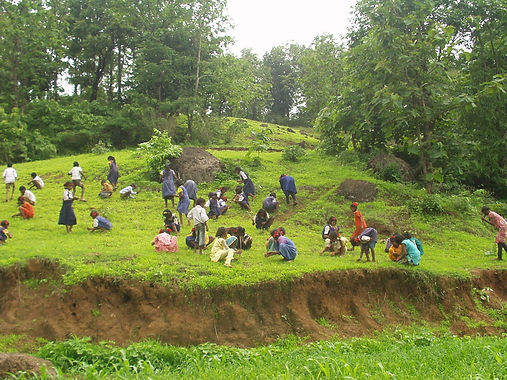
At Maharashtra Prabodhan Seva Mandal (MPSM), we ran a program to preserve and hand down knowledge of traditional forest foods and their benefits. At the monthly Self-Help Group meetings, under the supervision of village elders, the women would collect and prepare one or two forest foods to be eaten with hand-made breads brought from their homes. Some plants, easily available in years gone by, were now rare, forcing the question, “Can we regenerate these in the forest and wasteland near the village?”
In another program, we provided hundred forest plants to any Adivasi who would dedicate half or one acre of grassland/wasteland to regenerate a micro-forest. On one of my visits, I was surprised to see the saplings flourishing among waist-high grass. In response to my query, the elderly man replied, “I will not cut the grass and sell it like everyone else does. I will allow the grass to return to the soil. I have planted trees; I have to provide them nourishment”.
An elderly Adivasi who had planted over a hundred hardwood, mango and cashew plants on his wastelands explained himself thus, “My sons will pursue a life in the cities, and my daughters will marry into other villages; these, pointing to the trees, are the daughters and sons that will care and provide for me in my old age.”

Adivasi folklore is full of tales of the spirits of the forest that live in the trees. My favourite is of the young men who had gone deep in the jungle to collect honey. Seeing the honey-laden combs, they were driven by greed and took everything, leaving nothing for the gods. Not surprisingly, the spirits pursued them on the way home and ensured they paid the price.
In these last monsoon months, more than 10 different wild-growing (weeds) plants that have reached our table, thanks to the Adivasi woman who looks after our eco-campus here at Tara. As the wet season gives way to cold and dry, the greens will become flowers and fruits and roots; many of these plants having innate nutritional properties. In a moderately populated Adivasi village in a relatively healthy forest, no Adivasi family will ever have to go without food.
These are just a few examples of the interdependence and the bonds that hold the forest community together and how conscientious Adivasis try to foster them. In our world, where human supremacy over creation offers many short-lived benefits, let us choose to build our narrative on traditional wisdom.
Wendell D’Cruz, S.J.


Comments